Thursday, July 11, 2019

Feelin' the Spirit


The one-room church. The members are slowly building a new,
larger sanctuary as money allows. 
From Noel:

This past Sunday, we had the opportunity to worship at the local church in the village where Moses, our friend and guide for the week, grew up. We got in the cars Sunday morning and headed off. Within 15 minutes we arrived at the church building, which turned out to be a mud-walled room with a tin roof. We got out of the car to sounds of a worship team practicing. We had arrived at the time church was supposed to have been starting, but of course with “Africa-time,” times are always approximations, and our small group of 8 was the majority of the people there. However, worship began and people began showing up and filling the small room.

Pastor Charles helps lead the joyful singing.

We began with songs, and we all stood up not really sure what we should have been expecting. Worship went like this: a man stood up and began chanting songs through a microphone. They were very obviously praise songs and, to my surprise, every person in the room knew them well, because their responses were perfect and harmonious. The call and response went on for some time. We tried our very best to sing along with some of the Swahili words, but I personally couldn’t get the full sentences down, even after 50 repetitions. However, as the songs went on, we got more and more comfortable with the environment and the worship. The church members worshipped freely and passionately, with lots of call outs of “Amen” and hands raised and waving back and forth. After a while, it became easier to fall into my own form of worship and prayer, even if I couldn’t sing along as I would normally do.

After the worship, the main worship leader remained standing and also played the role of preacher (I am starting petition to have Pastor Jeff Chapman single-handedly lead the singing at Faith Presbyterian). He preached a beautiful sermon on the theme of peace in a couple of chapters of Isaiah. His English was very good, so he preached in English with a translator for the rest of the church.

After the sermon, I was ready for maybe a quick offering and then a benediction and then we would be off. Boy, was I wrong. We remained in church as different pastors came up and gave thanks and prayers, encouraged the church and each other, took offerings, thanked and introduced us, and worshipped. At certain points that seemed to me to be spontaneous, certain members of the small church would stand up and lead a call and response song or a choir would come up to the front and sing and dance and praise.

Moses Osoro with all the children gathered outside the church.
After a few hours of worship, Moses led us out of the church in the midst of the continuing worship. He informed us that if we wanted to stay for the whole church service, we would be there for another 4 or 5 hours at least. Despite it being a completely foreign church experience in the midst of my year of all kinds of church experiences, I left very encouraged by the passionate praise, mutual encouragement, and never-ending gratitude of the whole church. There wasn’t one member there that Sunday who was there simply because they felt some sort of Sunday morning obligation to be seated in a pew. They were all there because they felt a need to praise their Lord and Savior.

Pastors Charles and Benjamin show Jeff the footprint of their new building.
They told us they collect enough offering to pay them about $2 a week -- not nearly
enough to support their families. It is a labor of love for this community.


Tuesday, July 9, 2019

Kingdom Work in Kenya (Presbyterian Style)


Some unexpected days in Nairobi led to some unexpected opportunities to see some vital mission work being carried out by the Presbyterian Church of East Africa (PCEA).  At the suggestion of our friend, Pastor Karanja, we were able to visit two ministries in the area supported by his and other local Presbyterian congregations.

Math class at the School for the Deaf
The first day we visited the Kambui School for the Deaf, home to nearly 300 students ages 6 through high school.  It would be difficult, if not impossible, for these students to receive an education anywhere else.  At this remarkable boarding school, however, these students are able to pursue an education that will help prepare them to one day enter the workforce.  Many of them will ultimately be trained in one of the trades, but a few go on to  We even met a few who have returned to the school as teachers.  A very small number will even have an opportunity to enter university and later pursue one of a variety of professions.

A deaf choir singing to us about Jesus' love!
We will not soon forget the experience of sitting in on a high school algebra class full of eager students.  I (Jeff) do not  know that I have ever been as impressed with a teacher as I was with the man leading this class.  I have never before considered how difficult it would be to speak the lesson (for those students who can read lips), use sign language at the same time, all while writing equations and other formulas on the chalkboard.  Disabilities are difficult enough to overcome in the developed world.  These students so impressed us with their determination to not allow their disabilities to stand in the way of them receiving an education.  The day was capped off when the entire student body gathered to sing (in sign language) a Kenyan version of Jesus Loves Me. 
School children waiting for a dental check up

The second day we visited Kikuyu Mission Hospital, also sponsored by the PCEA.  This hospital, founded nearly 100 years ago by Scottish Presbyterian missionaries, provides vital health care to the surrounding Kikuya area (not far outside of Narobi).  Many in the area are poor farmers who otherwise would not have access to adequate healthcare.  The facility is an extensive maze of various clinics.  The jewel of the hospital is their vision clinic, renowned in the entire region and beyond for the services they provide.  We witnessed a busload of children waiting to receive dental checkups aided by an American/Canadian team of dentists providing extra support..  Among the other services we saw were a prosthetics lab where artificial limbs are engineered and custom-fit and a dialysis unit that is a life-saver for its patients.

Both days left us with a deep admiration for the commitment of the PCEA to the community it serves.  These are massive efforts affecting thousands of lives and it is all being done for the glory of God through the work of Presbyterians!  It made us all proud to share a faith tradition with these brothers and sisters and left us inspired to answer God’s call by finding ways to better serve those in need in our own community back home.

Friday, July 5, 2019

Unexpected Blessings


YaYa Village
As I reported in an earlier post, we had to cancel our trip to northern Ethiopia due to some instability in that part of the country. We have spent this week instead in and around Addis Ababa, two nights at the Equip Ministries guest house and two nights back at YaYa Village the resort in the mountains that has a decent running track.

What started as a disappointing turn of events has turned out to be a nice time of rest and respite. We had time to get caught up on communications (WiFi at last!), sleep and laundry. We also got to participate in some of the activities in and around Equip. One evening we attended a concert of Ethiopia’s most popular Christian music artist. We couldn’t understand a word, but the young people in the audience were going crazy, singing and dancing. (It reminded Isabel and Noel a bit of Hillsong concerts, for those who know them.) We also attended church with the Equip staff and joined them for lunch and gelato – our first ice cream since leaving the States. One morning, we sat in on a meeting of a former Muslim who was called into the Christian faith by a miraculous event. For the last 25 years, he has been reaching out to Muslims throughout Ethiopia to spread the gospel. He had some really profound thoughts on how this can be done in a peaceful and effective way.

Now we’re enjoying the lovely YaYa resort, including the cleaner air and all the amenities like a gym, swimming pool and beautiful grounds. Isabel and I are even getting massages today – at $9/person, who can resist?

All this to say that sometimes a change of plans is not what we want, but just what we need.

And now, we are leaving Ethiopia for Kenya. Before we go, I wanted to reflect on a few random things I’ve noticed in the 2 ½ weeks we’ve been here:

One of the obstacles on a typical
Ethiopian road.
*Driving is an art, not a science – Much of our time here has been spent in the car, so I’ve had plenty of opportunity to analyze the driving style here. First, it’s typical non-Western chaos, with traffic laws being largely ignored. Drivers drift across lanes at will, cut one another off constantly, double park, pass in dangerous places – one giant game of chicken. Yet I’ve witnessed zero accidents and zero accounts of road rage. The people here have a pretty patient approach and an overall perspective that we’ll get there when we get there. I especially enjoy the apparent pecking order that goes like this: faster cards and SUVs have priority on the road, with taxis, buses and trucks pulling aside to let them pass. At the top of the pecking order though, surprisingly, are the goats, cows and donkeys that wander into the streets at will. Drivers slow down or come to a complete stop if necessary to safely pass. I understand that’s because anyone who hits an animal has to pay up on the spot.

*You would never be lonely in Ethiopia. There are many things that need improvement in this developing country, but it’s undeniable that this culture places a high priority on community and cooperation. People gather in groups everywhere we look, having coffee at a sidewalk cafĂ© (essentially plastic stools placed in a circle under a tarp), helping each other fix a car, walking arm in arm, playing soccer in the street. I now see why Africans who come to America are dismayed – even spooked—by the empty streets. Where are all the people? We live in our cars or living rooms or backyards. And many people are very, very lonely because of it. I don’t think you could get lonely here.

Always many people outside in Ethiopia.

Bereket made many little friends in Abaya.

*Free college here. As I've listened to the Democratic candidates for U.S. President advocate for free college, I have not been convinced it would be financially feasible. But Ethiopia has free college tuition, and I spoke to many young adults (including Godebo's and Bereket's brother Daniel) for whom this policy has been monumental. It also seems to offer promise for the nation as they are able to train and then maintain professionals such as road engineers, architects, teachers, environmental specialists, etc. What would free college do for the U.S. in lifting up the disadvantaged, advancing science and technology, even transforming our political culture? It's worth considering.

*Traveling in a developing country exposes my weaknesses. As I’ve waited…and waited…for meals at restaurants, fiddled with hotel lights or showers or TVs that do not work, sat in gridlock, endured countless power and water outages, been unable to communicate, I’ve realized something about myself: I’m not very resilient. My comfortable American life has left me feeling pretty pampered and entitled, and I don’t roll with the punches as much as I’d like to imagine. Ethiopians are resilient and adaptable. They are also very optimistic and generous. I have a lot to learn from them.

The family of one of our World Vision sponsor kids took time to create this
welcoming canopy decorated with fresh flowers. 


Thursday, July 4, 2019

A Joy-Filled Reunion


On June 27th, we got to experience what we’ve imagined for the past 11 years: reuniting with Bereket and Godebo’s birth family. Here are the kids’ reflections on that experience.

Reflections from Bereket:

Mixed Emotions

“How do you feel about meeting your family?”

Over the last few months, I’ve received so many questions about how I feel about meeting my family. And I don’t resent the questions because I know they were asked out of love for me and genuine curiosity. But I’m not going to lie and say that I enjoyed being asked about this topic, because I truly had no idea how to put into words the emotions I was feeling. I knew this experience was a once-in-a-lifetime opportunity and I was grateful for it, but there was also a part of me that really didn’t want to go through with the meeting. I didn’t know why that was…and I still don’t know why I felt that way and to be honest I was a little ashamed for feeling that way. But my guess is that I was afraid of the fact that I had no idea how meeting my family was going to leave me feeling emotionally or how my own birth family was going to feel about me. So half of my heart was excited and curious to the idea of meeting my family while the other was fearful and dreading that same idea.

The Meeting

The day of the meeting I was filled with nervous jitters, dread, and excitement. I wore a traditional Ethiopian dress and some jewelry but kept my face completely bare because I wanted my family to see the face I was born with (nothing added or changed). We traveled by car on some bumpy roads to a school house where the meeting was to take place. Beforehand we bought some gifts for the family including a necklace for my mom and some cooking items that Tamiru, our World Vision guide and friend, said might be useful for them. We were accompanied by two translators, one who translated from English to Amharic (the main language) and the other who translated from Amharic to Hadiya (my family’s village language), and vise versa.

We had gotten the times mixed up so we were pretty late when we walked in (oops!), but that didn’t change the fact that when we entered the room everyone stood up and started embracing one another. There were plenty of tears, long hugs, and loving words whispered that I couldn’t understand. Later, we sat down on some long benches and talked for a few hours. The night before, Godebo and I had made a list of questions we wanted to ask and to my delight the conversation flowed seamlessly. I found out that I’m an aunt to four kids that my oldest brother has and that when I was little I liked to play with mud. Throughout the discussions we learned small but meaningful details as well as some much-needed answers like the fact that my family members are also believers in Christ. We learned that they are all doing well and pray for us often. My brother Daniel (after whom I was given my middle name, Danielle) was able to finish school, go to college, and get a job as the human resources manager at a nearby high school.  Two of my other brothers as well as my sister weren’t able to come because they were out of the country for work purposes, which made me very sad. After discussing and catching up on life from the past 11 years we presented our gifts, took lots of pictures, exchanged some contact information, and prayed together.

The Departure

We were walking out hand in hand when all of a sudden a group of people came toward us, arms wide open and tears in their eyes. I later found out that these were members of my extended family. Aunts, uncles, cousins -- even my sister-in-law. We left shortly after embracing them. This was definitely the hardest part, with many tears and much heartache. The reality is that we may never see them again and my birth family may not be able to experience life with me, and that breaks my heart. Over these last few days, I've been thinking a lot about them and the future. I hope that one day,  Godebo and I with our own families will be able to go back to our village and reunite with them. If that isn't God's will, I'll have to be satisfied with occasional emails and the knowledge that we will be reunited in heaven when there will be no need of a translator.

Thoughts

Even though before I was very anxious about meeting my family, I’m so relieved and happy that I did it. I know that deep down I needed to know they are doing well and that they still wonder about me like I wonder about them. I think it was also important for me to learn about where I came from. Where I got my sassy personality and what I was like when I was little. I needed to hug the person who gave birth to me and know that she loves me more then I can imagine. It was also such a joy to find out that they are believers just like us, because now I know that no matter how far away I am from them we are united through Christ. I’m so glad that I had Godebo there the whole time during this journey because I honestly don’t know if I could’ve done it without him. I’m also eternally grateful for the Chapman family that is present in my life today. Their support and love helped everything to go smoothly. My wonderful family is a stronghold in my life and the Lord really blessed me with them. I am also filled with gratitude for my amazing church community that show me Christ’s love constantly, and for my caring friends who will listen to anything I have to say whether it be something big or small. This Tuesday I am so content and filled with gratitude for the Lord. THANK YOU GOD!


Reflections from Godebo

Three hours of joy, tears, and laughter

The idea of reuniting with my family members had been in my mind long before this trip, but when I found out that I had the chance to do it this summer I was shocked. I was both thrilled and a little bit nervous as well. Since I hadn’t been in contact with them for 11 years, I had no clue if all of them were in good health, were together, or if all of them were even alive! However, God was gracious to us when we received an email saying that all of my family members wanted to see me and Bereket.  That day I read the email over and over again not able to believe that I would see all my siblings and my mother, whom we thought was completely gone from the family. I could hardly sleep that night as I tried to picture what all of them looked like after 11 years.

The day of our visit, Bereket and I were filled with mixed emotions. We were anxious to meet our family but also unsure of what to expect.  I tried to comfort Bereket as it was very tough for both of us. When we entered the room, however, all those emotions were lifted away. It seemed as though my mind was erased and all I could focus on was the people in front of my face. I remember just going right into the arms of my mother without any hesitation and without any words. I am not an emotional person and I have never cried tears of joy but that day I did.

After we embraced, I got a chance to communicate with them. I wish I could have spoken to them in Hadiya (the language I grew up speaking), but I had forgotten how to speak it. But we had great translators who tremendously helped us communicate with each other. We went through our lives and theirs and had many laughs and applauds. My favorite part was listening to their memories of us and sharing my memories of my childhood. I had a few memories of my home that I always told my family and finally I got the chance to confirm that they were correct!

As we were getting ready to leave, I thanked God for the safety of our family and this chance we had to meet them. Leaving them was as emotional as greeting them, but this time I had reassurance and so much more joy. Before we left we got a chance to see our extended family. I wish I had a chance to talk to each one of them and learn who they were but we ran out of time. Still I have to be grateful that we got to see them. 

I told my Ethiopian brother Daniel that I didn’t understand adoption when I was younger, but now I understand that it’s a beautiful thing that can change someone’s life for the better. Bereket and I have lost nothing through adoption but gained two loving families and an opportunity to succeed in life.


Tuesday, July 2, 2019

Progress in Abaya


Clean water is life.  What we take for granted in much of America, is unfortunately a luxury in much of the developing world.  My (Jeff) third visit to World Vision’s Abaya Area Development Project (ADP) was a poignant reminder that the work being done here, especially to provide clean water to surrounding villages, is vital work.  With our trusted friend Tamaru, we spent two extraordinary days touring the ADP and seeing the progress which has been made since a team from Faith Presbyterian last visited in 2016. 

A highlight of the tour was a visit to a solar-powered water project.  Far into a remote part of the region we came upon an entire field of solar panels which powers a nearby deep well.  The solar energy, a rich commodity in sunny Ethiopia, ensures that the well will keep operating even during power outages, which are frequent in this part of the world.  Before this construction, the people of this particular remote village faced a two-hour walk to fetch water which was polluted by animals and unhealthy to drink.  Now this well feeds 5 separate water points (i.e. stations) which supply clean water every day to approximately 5,000 people.  The whole water project is overseen by a Water Committee made up of seven elected members of the community, elected because of their respected and trusted status in the community.  This committee, like all similar Water Committees, is made up of 4 women and 3 men (see photo).  The female majority is important because the women, having borne the previous burden of fetching the daily water, are most invested in the continued success of the project.


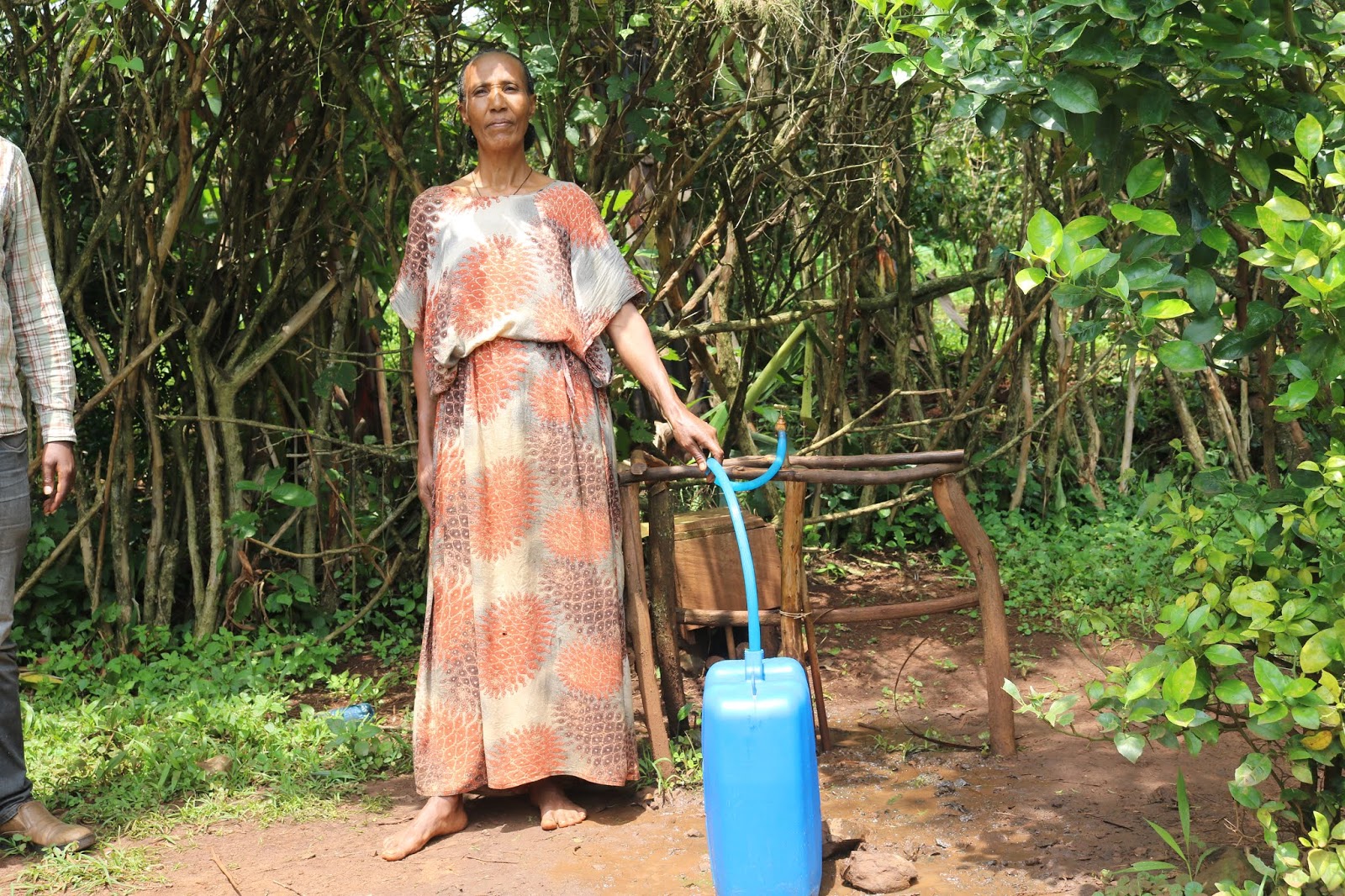
A recent development in the Abaya ADP is the installation of water taps at individual homes.  Any family willing to pay a minimal fee to the government, can request for an individual water line to run to their property so that they can access clean water right outside their home.We visited the home of a 50-year-old woman named Gifti Dadhakabo (see photo) and she demonstrated how her water tap now provides all the water her family of 12 people needs to drink, bathe, cook and do laundry.  It was clear that this development has made a world of difference for this family and many others like them.  Overall, clean water coverage in the Abaya ADP has been raised from 31% in 2009 to 62% today. 

Another highlight of our Abaya visit was the opportunity to visit the homes of our two sponsored children Daniel and Salamawheet.  We also visited with Bekasu, the sponsored child of Esther’s parents.  With the support of World Vision, both these children and their families are doing well.  The kids are in school and the families are safe and living with enough provision.  It is always a surreal experience to travel half-way around the world, drive miles into the Ethiopian bush, hike another few kilometers to a small hut never before visited by Westerners, and see a young boy emerge holding the picture of our family which we sent some years before. 


Finally, we were overwhelmed by the hospitality of Tamarat, the ADP director, and his marvelous staff.  We were humbled by a presentation they made to all of us of traditional Ethiopian clothing.  These men and women, true servants of Christ, are working tirelessly for the sake of the people of this community.  They were very eager to show us the work that God has done through them.  We all took great joy in the privilege it has been for us and our congregation back home to partner in this life-saving work.  As we left our visit, our hearts could not have been more full of gratitude. 


Sunday, June 30, 2019

Hospitality Ethiopian Style


Tsion preparing the coffee ceremony
Today was Sunday so we attended church with our friend Genaye at the International Evangelical Church, where her parents attend. The IEC was launched 40 years ago to minister to missionaries, diplomats and other foreigners in Addis Ababa, as well as the local community. The service is completely in English, and the guest preacher was a Texan who was part of a Dallas Theological Seminary training at the church, so it felt like home. We were actually a bit disappointed since we had been anticipating experiencing something new, but it was a very nice service all the same.


Worship at International Evangelical Church

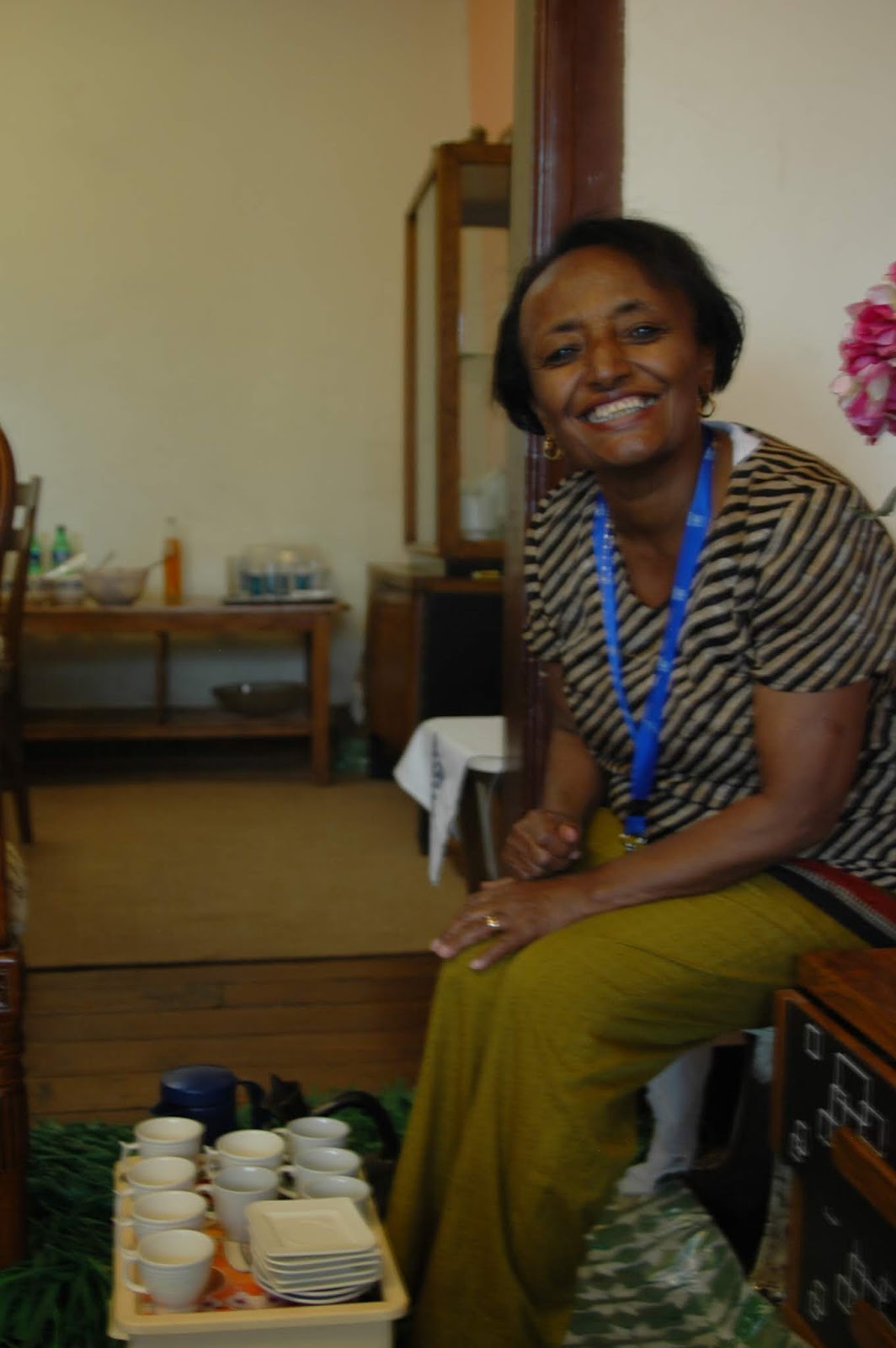
After the service, we were invited to lunch at Genaye's house. We know her mother, Tsion, fairly well, since Tsion has visited Sacramento several times to see her other daughter, Selam. Tsion made us a feast of Ethiopian food for lunch -- about 10 dishes in all. Then she brought out a giant object wrapped in a towel, which ended up being dufo dabo, a traditional Ethiopian bread. According to tradition, our family had to gather round the bread, put our hands on the handle of a long knife and make the first cut. I didn't catch the meaning of the tradition, but it was done with great fanfare. 

Cutting the dufo dabo


Then Tsion went through the Ethiopian coffee ceremony, which includes popping popcorn, lighting incense and heating the water and coffee grounds in a special pot over an open flame. The resulting brew is rich and thick and served in small espresso cups to be sipped and savored -- preferable with a lot of sugar. Like everything in Ethiopian life, the process is slow and patient, and Tsion told us the tradition is to serve three rounds of coffee to guests, the third one called the "blessing." So we enjoyed the coffee and the company.

Tsion and her husband are utterly delightful people who have lived a very full life. Tsion, especially, is a force of nature in her joy and vitality, and in the ways she serves her church and community. Right now, she is helping several handicapped people with their bathing each week. She is also putting several orphan children through boarding school and having them live in her home over breaks. And she has her own little soup kitchen where hungry people from the street can line up at her door for a meal. I love her spirit and admire her energy, so it was a privilege to spend time with her and her family.


Some cuddle time with Genaye's puppy. Most Ethiopian dogs are used as
guard dogs and can't be petted, but this little guy was friendly.

We were very full and satisfied after that meal, but then we got in the van and headed to dinner at Mamusha and Leke's home. As you may recall, Pastor Mamusha is involved with Equip ministries, pastors a church and travels the world speaking to churches and groups. He will be one of our African visiting preachers this summer. Leke served another large meal of Ethiopian food but we could barely fit another bite, so we just nibbled. We had a very interesting conversation, including much discussion about the recent coup attempt and assassinations. We feel so fortunate to be able to spend time with so many dynamic Christians and learn about their culture and country from them.

Saturday, June 29, 2019

Running at YaYa


Godebo and Bereket are missing out on summer cross-country conditioning, so we promised their coach we would do our best to find opportunities for them to run. After all, Ethiopia and Kenya consistently produce some of the best runners in the world, so we hoped we could figure out where they train and perhaps have Bereket and Godebo join them.

The first two times we tried this, rain got in the way, but today we got it right. Our driver took us to YaYa Village, a resort just outside Addis Ababa that was built by the most famous Ethiopian runner in history, Haile Gebreselassie. After he retired from running, he became a businessman and built several resorts around Ethiopia, and one of them, YaYa Village, has a running track used by local runners to train.

We arrived around 7 a.m. and already there were about a dozen runners training. Godebo and Bereket jumped right in, with Godebo even joining a group of male runners for much of his workout -- and they set a pretty fast pace. The elevation (about 8,000 feet) provided extra challenge, but both kids got a good workout and really enjoyed running with some very talented athletes. Meanwhile, Jeff walked the track, I did run-walk intervals and Noel found a decent weight room for his workout, so we all appreciated the chance to move our bodies and sweat a bit.

After the workout, we got a private tour of the small Haile museum from the YaYa Village manager, and then we had a nice brunch at the restaurant before heading back to Addis. It felt great to move our bodies and get out of the bustle of the city.